
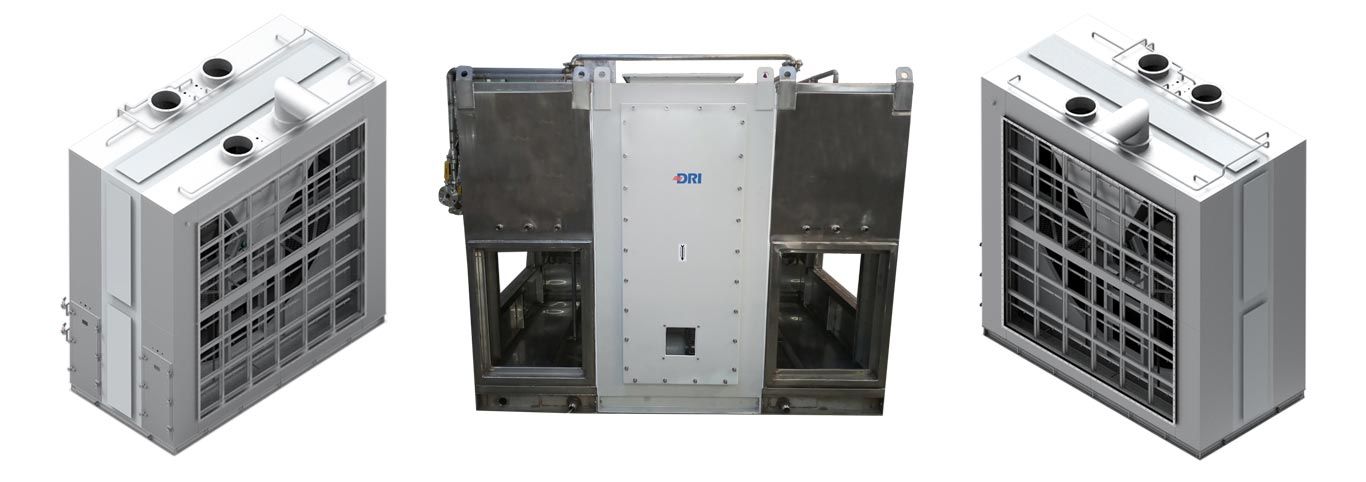
In the process, the VOC Concentrator Rotors adsorbs volatile organic compounds (VOCs) onto a continuously rotating Zeolite rotor. The rotor is divided into three sections: the adsorption zone, cooling zone, and desorption zone. VOC-laden air passes through the adsorption section, where VOCs are removed from the process stream and adsorbed onto the Zeolite rotor. The treated exhaust air, containing significantly reduced VOC levels, is then discharged to the atmosphere.
Adsorption/Process Zone: Exhaust air from the process area, characterised by low VOC concentration and high airflow volume, is directed through the rotating Zeolite rotor. In the adsorption/process zone, the Zeolite media adsorbs VOCs and other pollutants from the air stream.
Cooling Zone: The performance of the Zeolite rotor improves at lower temperatures. In the cooling zone, the rotor is cooled to maintain its adsorption capacity. During this process, heat is recovered to help reduce the energy required for regeneration.
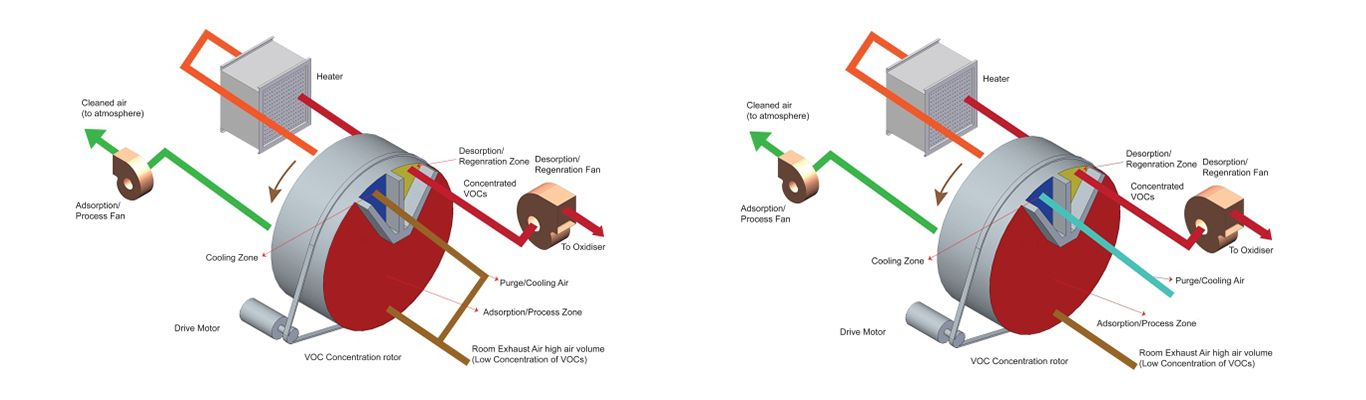
Desorption/Regeneration Zone:
The rotor undergoes continuous regeneration as it rotates from the adsorption zone to the desorption zone. Hot air at 180–200°C desorbs the VOCs from the rotor, creating a concentrated VOC stream. The concentration ratio can reach up to 30 times, with typical values between 10 and 25 times.
| Industry | Application Areas | VOCs Treated |
|---|---|---|
| Coating (Tapes) | Coating process | Ketones (MIBK, MEK, Cyclohexanone, etc.) |
| Chemicals (Bio-Gas Plants) | Oil refinery, Reactors | Alcohols, Aromatic compounds |
| Automobile | Paint booth | Alcohols, Xylene, Esters, Toluene |
| Printing | Film, Can, Packaging Dryer | Alcohols, Toluene, Xylene, Esters |
| Electronics | Semiconductor cleaning units | Ketones, Alcohols |
| Plastics | Polyethylene (PE) material processing (extrusion) | Styrene, Esters |
| VOC | EcoV1 | EcoV2 | EcoV3 | |
|---|---|---|---|---|
| Alcohols | Butanol | |||
| Ethanol | ||||
| Methanol | ||||
| IPA | ||||
| Aromatic compounds | Xylene | |||
| Tri methyl benzene | ||||
| Toluene | ||||
| Styrene | ||||
| Esters | Butyl acetate | |||
| PGMEA | ||||
| Ethyl acetate | ||||
| Ketones | MEK | |||
| MIBK | ||||
| Acetone | ||||
| Cyclohexanone | ||||
| Others | NMP | |||
| DCM | ||||
| Naphtha |
| EcoV Series Model No. |
Process Air Flow | Dimensions (in mm) | Estimated Weight (in kg) |
|||
|---|---|---|---|---|---|---|
| CMH | CFM | Length (L) | Depth (D) | Height (H) | ||
| 1220 | 7400 | 4355 | 840 | 1550 | 1650 | 850 |
| 1525 | 11500 | 6768 | 840 | 1850 | 1950 | 1050 |
| 1740 | 15100 | 8886 | 840 | 2050 | 2150 | 1250 |
| 1940 | 18750 | 11034 | 840 | 2250 | 2350 | 1365 |
| 2190 | 24000 | 14124 | 840 | 2500 | 2600 | 2100 |
| 2450 | 30000 | 17655 | 840 | 2800 | 2925 | 2520 |
| 2650 | 35000 | 20598 | 840 | 3000 | 3125 | 2950 |
| 2950 | 43500 | 25600 | 840 | 3300 | 3325 | 3465 |
| 3250 | 52500 | 30896 | 840 | 3600 | 3850 | 3780 |
| 3550 | 62800 | 36958 | 840 | 3900 | 4150 | 4520 |
| 3850 | 74000 | 43549 | 840 | 4200 | 4450 | 5350 |
| 4200 | 88000 | 51788 | 840 | 4550 | 4800 | 6000 |
| EcoV Series Model No. |
Process Air Flow | Dimensions (in mm) | Estimated Weight (in kg) |
|||
|---|---|---|---|---|---|---|
| CMH | CFM | Length (L) | Depth (D) | Height (H) | ||
| 1220 | 7400 | 4355 | 2100 | 1550 | 1650 | 1200 |
| 1525 | 11500 | 6768 | 2100 | 1850 | 1950 | 1500 |
| 1740 | 15100 | 8886 | 2100 | 2050 | 2150 | 1600 |
| 1940 | 18750 | 11034 | 2100 | 2250 | 2350 | 2100 |
| 2190 | 24000 | 14124 | 2100 | 2500 | 2600 | 2600 |
| 2450 | 30000 | 17655 | 2100 | 2800 | 2925 | 3400 |
| 2650 | 35000 | 20598 | 2100 | 3000 | 3125 | 3700 |
| 2950 | 43500 | 25600 | 2100 | 3300 | 3325 | 4300 |
| 3250 | 52500 | 30896 | 2100 | 3600 | 3850 | 5300 |
| 3550 | 62800 | 36958 | 2100 | 3900 | 4150 | 5900 |
| 3850 | 74000 | 43549 | 2100 | 4200 | 4450 | 7100 |
| 4200 | 88000 | 51788 | 2100 | 4550 | 4800 | 7800 |
VOC Concentrator Rotors is a system that adsorbs volatile organic compounds (VOCs) onto a continuously rotating Zeolite rotor. The rotor is divided into adsorption, cooling, and desorption zones to continuously remove and concentrate VOCs from the process air stream.
In the adsorption/process zone, exhaust air with low VOC concentration and high volume passes through the rotating Zeolite rotor. The Zeolite rotor adsorbs VOCs and other pollutants, while the treated air exits the adsorbent section with most VOCs removed.
The cooling zone cools the rotor to maintain its adsorption capacity. During this process, heat is recovered to help save regeneration energy.
As the rotor moves from the adsorption zone to the desorption zone, it is regenerated continuously. Hot air at 180–200°C desorbs the VOCs from the Zeolite rotor, and the leaving air becomes concentrated with VOCs.
The concentration ratio can be as high as 30 times. Generally, the concentration ratio is around 10–25 times.
Fill in all the details. Our Team will verify your details & reply within 24 hours.